Friday, October 11, 2013

Tirta Gangga Water Palace, East Bali

Tirta Gangga (Tirta means blessed water, Gangga originated from Ganges, the holy river in India) is a well-known tourist attraction in East Bali. Tirta Gangga is a water palace which was built for and belongs to the royal family of Karangasem. We were told by our guide that the palace was erected as a retreat destination for King Anglurah Ketut Karangasem, (who was the the last king of Karangasem) and his royal family.

Subsequently, through my own research, I found out that the Raja not only did all the designing himself, but he also worked together with his laborers to complete this water complex. For the first time in my life, I have newfound respect for a King.

Entrance. Ticketing booth is on the right (hidden in picture)


After paying the entrance fee (10,000 IDR for foreigner visitors, 5,000 IDR for locals), we walked in and the gorgeous palace stood before me in all of its royal glory. From the entrance, the first noticeable construction is the Mahabharata pond and the Nawa Sanga fountain, and within a minute, I was standing atop the stepping stones in the middle of the pond surrounded by koi fishes and majestic stone sculptures on water.

Beyond the pond is the 11-tiered Nawa Sanga fountain tower.

Mahabharata pond and the 11-tiered Nawa Sanga fountain (behind)

Mahabharata sculptures

You can walk across the pond on its large stepping stone.

Pouring water from the tower sculptures.


Behind the Nawa Sanga fountain tower is a swimming pool (not in picture), which used to be a pool for royal baths. These days, visitors can jump in for a nominal fee. It is believed that water had healing properties since it ebbs from natural spring, and has always been regarded as holy by the locals.

Notice the clarity of water which is fed directly from the holy spring.

Koi fishes longer than an arm's length

Decorative lotus pond

Lotus flower in full bloom


Whereas the Mahabharata pond is on the right, the left side (from entrance) is occupied by the South Pond, or generally referred to as the Water Garden, with the long Demon island in the middle.


West bridge on Water Garden


Demon island


Tirta Gangga is a pleasant place to visit, and it is respected by everyone as a spiritually clean place. Besides the water palace, which is the main draw of this place, Tirta Gangga is also surrounded by hills. plantation and stunning rice paddy terraces, which makes it a photo-worthy spot.

The driver drove us to a nearby spot (also reachable on foot, approximately 10 minutes) for a better view of the terraced paddy fields. The mountain which you see below is Gunung Agung (Mount Agung), a volcanic mountain which is still active. It last erupted between 1963-1964.


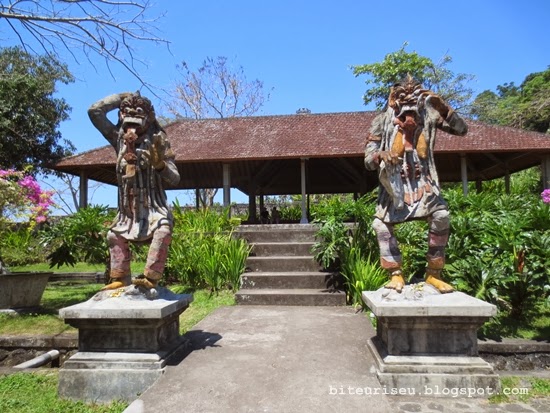
Surrounded by classical sculptures and thanks to its significant historical value and beauty of surrounding (water, hill, and garden), Tirta Gangga became one of the best spot in Bali. It's not in your everyday life that you see a water palace right?

Serene and calm, Tirta Gangga is a comfortable escape from high-rise skyscrapers.

The best hour to visit is between 9am to 11am, lest you want to get a sun tan ;)

Tuesday, October 8, 2013

White Sand Beach, a hidden gem at Candidasa, East Bali

Candidasa (pronounced Charn-dee-da-sa) is a seaside town located in East Bali. The town, two hours away from Ngurah Rai International Airport, is quieter and steers away from the crowd that flocks to the hotspots in Central and South Bali.

Up until the 70s, Candidasa is a quiet fishing village but much has changed with its gradual development of vacation hotels. Nonetheless, the town is still pretty serene compared to other places in Bali. Like what our drivers/guides say, Candidasa is for those who are looking for a tranquil vacation because the town is practically dead by 11pm. However, during the day, you can still partake in tours, snorkeling, sight-seeing by boat, water sports, etc. If you're a party-goer, it's still best to stay in (the over-commercialized) South Bali.

As for us, a spa and relaxing vacation was what we wanted, we skipped all visits to Central/South Bali due to the distance. I didn't want to spend 4 hours on the road, only to have 30 minutes or less to stop by at each tourist spot. Not forgetting, I have really bad motion sickness. 

Thanks to reviews on Tripadvisor, I found out about White Sand Beach, which is definitely a hidden gem in Candidasa. Because the beach is isolated from town (and where majority of the hotels are), not many are aware of the beach (assuming no travel research is done). On the day of our visit (a sunny Thursday), there were less than 20 of us at the beach. Okay, perhaps 30 including the people who runs the warungs (food stalls) there.

I'll let these pictures and videos do the talking.


White sand and crystal clear aqua water


The vomit-inducing (because I have motion sickness), bumpy car ride (approximately 15 minutes car ride from Candidasa town) was all worth it the moment I step foot on the beach. There are a few warungs (food stalls) on the beach to feed the hungry. Sunbeds and umbrellas available for rent for 15,000rupiah (less than USD$2, for unlimited hours). Sight-seeing on boat from White Sand Beach can be arranged.

Monday, September 30, 2013

A temple on rocks, facing the sea? It's Haedong Yonggungsa in Busan.

After checking in, we took a short rest and then left for Haedong Yonggungsa  해동용궁사, a temple which is no doubt, unique of its kind. Besides a place for worship, what makes the temple unique and now a tourist must-go is that Yonggungsa temple sits on a rock facing the sea, whereas most temples in Korea are located in the mountains. 

At the entrance, you will see twelve signs of the (Chinese) zodiacs - Rat, Ox, Tiger, Rabbit, Dragon, Snake, Horse, Sheep, Monkey, Rooster, Dog and Pig. In the Chinese and Korean culture, each calendar year is marked by an animal, which is deemed to have specific characteristics that are shared by people born in a specific year. 

Legend had it that Buddha called all animals of the world when he was about to leave this world, but only twelve came. Buddha named each year after these twelve animals in the order they arrived. The rat arrived first and the ox came next, followed by the tiger, rabbit, dragon, snake, horse, sheep, monkey, rooster, dog, and pig. Hence, they became the zodiacal animals we know today.


Further up, you'll see a Traffic Safety Prayer Pagoda, which road users pray to for safety.

Traffic Safety Prayer Pagoda


After descending 108 steps, the beauty of the temple can be seen.  The 108 steps in Buddhist temples symbolizes the journey to enlightenment, although some say 108 represents the hundred and eight agonies and suffering in mankind.


108 steps and stone lanterns

Halfway through the stairs, you can catch a glimpse of the magnificent and peaceful view already. From here, you can get some great pictures of Haedong Yonggungsa Temple. The white bridge (picture below) connects to the main temple, shrine hall, pagoda and Goddess of Mercy statue (via a separate flight of stairs).

As you’re crossing over the bridge, you can toss a coin into the turtle-shaped statues to make a wish. I tried, and failed. Sad. Not exactly an auspicious day for me. Heh!


Or you can climb down to the rock stones if you wish to take the picture from a different angle.


Sound of waves, peaceful on top of peaceful.

Golden Buddha


The Dragon King / King of Ocean

You will see a lot of Buddha statues in different sizes and colors around the temple, which devotees pray to so different blessing are bestowed upon them, for e.g. happiness, academic achievement, love, wealth, health, fertility, (there's a Buddha of Granting A Son statue, mm-hmm) etc.


Laughing Buddha
Guan Yin, Goddess of Mercy, known for her compassion and loving nature


If you’re in Busan, pay Yonggungsa temple a visit. It's breath-taking and undeniably, it is one of the most picturesque temples in all of Korea.


How to get here?
1. Alight at Haeundae Station (Busan Subway Line 2), and get out from Exit 7. 
2. Take Bus #181 and get off at the Yonggung National Fisheries Research 용궁사 국립수산 과학원 stop. When the bus announces ‘Yonggungsa’, it's time to alight. It takes about 20-25 minutes to get here from Haeundae station.
3. From the stop, walk approximately 15 minutes up the steep road.